Wednesday, May 31, 2006

To Buda or not to Buda


It's that time of the year again. Time to plan how not to be in this city for as much of the next three months as possible.

Which brings me to Budapest, where a friend from college has been living and working. And where she won't be living for much longer, so if I want to experience the city like a local, I need to make a plan.

I could visit the Bélyegmúzeum (Postal Stamp Museum) or the Victor Vasarely Museum.

Monday, May 29, 2006

Honey, I love what they've done with the pilasters


One good thing about having your beach house renovated over Memorial Day weekend is that it gives you time to really enjoy the city's cultural attractions without the usual hoi polloi getting in your way - just well-mannered tourists stalking every attraction in a slow-moving, fanny-pack and flip-flop brigade.

So I set off to the Upper East Side again to visit museums, this time the Cooper-Hewitt National Design Museum, in the landmark Andrew Carnegie Mansion on Fifth Avenue, and the Metropolitan Museum of Art, further south.

At the Cooper-Hewitt is Feeding Desire: Design and the Tools of the Table, 1500–2005, which addresses "the development of utensil forms, innovations in production and materials, etiquette, and flatware as social commentary." You might think that the history of silverware is an esoteric subject, but to judge by the number of people who were fixated by every piece, it may be underexamined. Upstairs is Frederic Church, Winslow Homer, and Thomas Moran: Tourism and the American Landscape, an exhibition of painters who romanticized the country's pristine beauty. The idea here is not just to highlight beautiful landscape paintings, but to show how they contributed to tourism. Each room is organized around a popular vacation destination, such as Niagara Falls or the Catskills, and offers a historical look at what tourists would find there and how these places were memorialized.

Over at the Met, which was open today thanks to our mayor, is Girodet: Romantic Rebel, a retrospective devoted to Anne-Louis Girodet de Roucy-Trioson, the apparently arrogant pupil of Jacques-Louis David. Here I saw many paintings that were familiar from art survey classes, though for some reason they were all hung at the eye level of an NBA All-Star. Girodet's artistic reputation is still being debated: some call him a good comeback story, while others think he might be better left forgotten. I'm not so picky about my Romantic painters - I loved it.

Sunday, May 28, 2006

Artstar - reality TV about artists

Jeffrey Deitch, on how the contestants were chosen: "It's not that different from the way we look at artists who we want to get involved in the gallery. It's the whole personality. And generally people who, in their way, have a very distinct personality are often the more interesting artist."

Seems like only yesterday they were sprawled out in Harper's Bazaar


Kimberly Guilfoyle and furniture heir Eric Villency were married yesterday in Barbados. The bride's previous marriage, to San Francisco Mayor Gavin Newsom, ended in divorce.

When did that happen?!?

Diving into the dreck


The Strand is having a sale this weekend - $10 for as many books as you can stuff into a shopping bag. Before you get too excited, these books cost $1.00 each, so it's safe to say that you are doing them a bigger favor than they are doing you.

I decided to dive into the dreck anyway. I passed on countless first novels (do authors whose first novels wind up on the $1.00 table ever write second novels? And why do so many have pictures of the ocean on their covers?), books by or about Linda Ellerbee, books about "extraordinary women," the memoir of a female martial artist, Inviting God to Your Wedding, and the like.

But then I found The Man Who Tried to Buy the World: Jean-Marie Messier and Vivendi Universal (who doesn't love reading about a business scandal in the summer, especially if it involves a flamboyant Frenchman?) and David Halberstam's War in a Time of Peace: Bush, Clinton, and the Generals, a completely out-of-date look at America's foreign policy.

Awesome, right?

Saturday, May 27, 2006

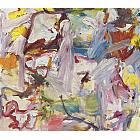
Charlotte Nicholson


Stealing an idea from Greenpoint blogger Art Soldier, I have been looking at the online image database at Artists Space, which is free of charge and open to artists and curators.

Looking at art this way is not ideal, of course - it's like flipping through a magazine but worse, because it benefits only work that looks good in a small jpeg file. That said, it's quite addictive, and the easiest way I've come across to see large quantities of not-yet-mainstream art.

The first artist to catch my eye was Charlotte Nicholson, a young Brooklyn artist. (I think "young Brooklyn artist" probably applies to most of them.) Using oil paint and sometimes gold leaf, Nicholson applies tiny brush marks to build up an impressionistic atmosphere over fairly large canvases.

Friday, May 26, 2006

Desmond Dekker dies


Jamaican legend Desmond Dekker has died at the age of 64.

I used to listen to his song Israelites in college and replay it about 50 times, because that's how many times you have to hear it to get it out of your system. Now that I think about it, I probably only knew about it because it was in the movie Drugstore Cowboy, from 1989.

Anne-Louis Girodet-Trioson - brainy, chilly, sexually ambiguous, louche


From the New York Times:

"[Girodet's] Sleep of Endymion was a Vargas pin-up, a muscled shepherd reclining on a leopard skin bed, ravished by a shaft of light, which is meant to represent the goddess Diana, who hovers like the scent of rosewater in the air around him. When Balzac saw the painting, he asked whether he could be left alone with it. Endymion made Girodet instantly famous."

Girodet: Romantic Rebel is at the Metropolitan Museum of Art.

Tuesday, May 23, 2006

Chinese art and townhouse envy


Tuesday night I went to the opening for Jiang Hu: Contemporary Chinese Art, a survey of established and emerging Chinese artists, at the Tilton Gallery on East 76 Street - the first opening I've ever attended that featured a brief performance of classical Chinese opera.

The Upper East Side is not an area I generally associate with galleries, though it certainly boasts a few; instead I tend to think of museums, Madison Avenue, the Central Park Zoo, and elderly fathers with their trophy wives, pushing lab-hatched offspring around in Bugaboos. But contemporary Chinese art? No.

Unfortunately, the Tilton Gallery is in a distractingly beautiful townhouse at 8 East 76 Street, just off Central Park. Unfortunate because anyone accustomed to the warehouse spaces of Chelsea is unlikely to notice any art when there is so much prewar detail on display. The gallery apparently moved to its current space in 2005, and takes up two full floors (two gorgeous, herringbone floors). It has large windows at the front and back (the better to see your well-heeled neighbors on their way to Café Boulud), fireplaces, and curlicue molding snaking up and down every wall. This is the sort of building for which real-estate-obsessed New Yorkers would gladly give up limbs, children, or personal ethics. Am I exaggerating? Not by much. Go see for yourself.

The art is funny. China is so trendy right now that it's hard to know what to think of it. A large neon sign by Sui Jianguo reads simply "Made in China," and has a price tag of $50,000. (Three words that have always meant "cheap." So naughty!) A portrait by Qi Zhi Long, of a young woman in Communist dress, is probably a good investment - a similar painting sold for double its high estimate at Sotheby's recent Contemporary Art Asia auction. The painting I'd most like to see in a museum collection, however, is a mottled, bloody-looking portrait by Yang Shaobin, "the Francis Bacon of contemporary Chinese art."

Sunday, May 21, 2006

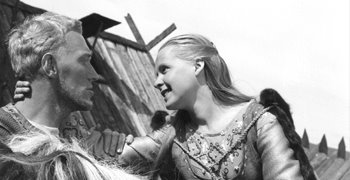
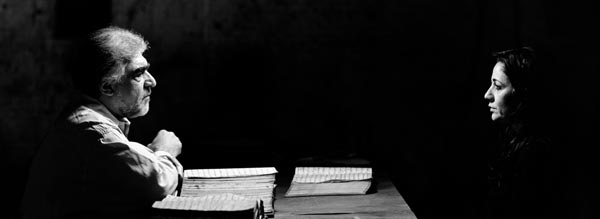
Ingmar Bergman’s The Virgin Spring - quiet, serene, and violent


Pagans and Christians, illicit pregnancy, sibling rivalry, brutality and vengeance in 14th century Sweden - Ingmar Bergman’s The Virgin Spring.

Saturday, May 20, 2006

The weekend is here, and it's off to a chilly start


"...always there is a tinge of sadness, a subtle indication of a tormented soul" in the art of Clifford Odets.

Interesting pairings: Buckminster Fuller and Isamu Noguchi at the Noguchi Museum in Long Island City, and Jean-Michel Basquiat and Jean Dubuffet at PaceWildenstein in Chelsea.

Wolfgang Tillmans gets his first large-scale US retrospective at Chicago's Museum of Contemporary Art.

Wednesday, May 17, 2006

Mary Ellen Mark


Mary Ellen Mark spoke tonight at the Strand Bookstore about two of her books: Falkland Road: Prostitutes of Bombay and Exposure, a collection of her most well-known photographs. She took questions from the audience about how she works and how she gains the trust of her subjects (with persistence). Being a female is an advantage, in her estimation.

I was surprised to recognize most of the images in her books, though I didn't think I was especially cognizant of her all these years. But her photographs are the ones you tend to stare at for a long time - portraits taken at odd angles, often a bit off balance, of people that you might not usually acknowledge.

Monday, May 15, 2006

Monday night and the rain has passed


Nicole Eisenman's Progress: Real and Imagined opened on Saturday at Leo Koenig - complete with film crew.

Architect Michael Arad’s Ground Zero memorial teeters on the brink of collapse.

Bloggers versus critics, an online debate: "If I were a newspaper editor, I’d be looking to the blogs for the next generation of critics." If only.

Sunday, May 14, 2006

Betty Woodman brings home the bacon


The Art of Betty Woodman, at the Metropolitan Museum of Art, is a good title for an exhibition that has to hoist ceramics over the great institution's lofty hurdle - it is art, in case you were wondering. I saw the show on my recent trip uptown, but it was hard to figure out what to make of such an aggressive onslaught of craggy form and exuberant color. (Peter Schjeldahl struggled a bit too.)

Good thing, then, that I stopped in to the Max Protetch gallery in Chelsea on Saturday, because there her recent work makes perfect, comforting sense. In these pieces, from 2005 and 2006, she sometimes incorporates canvas and paper along with her glazed earthenware. With this bit of context, her clay slabs become part of a larger pictorial plane, and her influences - like Bonnard and Roman art and architecture - help to place her in a grand aesthetic tradition.

Saturday, May 13, 2006

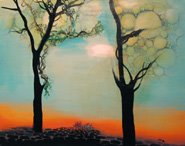
Luminous vapors and clouds - Jennifer Coates


Jennifer Coates paints what appear to be landscapes or expanses of sky, in vivid colors that throb and glow. But the imagery starts to melt on closer inspection, and magical things percolate on the surface: trees sway but don't have roots, apparitions appear and dissolve, bubbles coalesce, and prisms sparkle. In several places, veins or vines curl and intertwine, standing in for life amid so much atmosphere. The most successful, the brilliant Softwall, captures the atmospheric energy of a whirling vortex; Creeper, meanwhile, meanders beautifully but without a similar payoff.

Thursday, May 11, 2006

Now a zoologist wants to play matchmaker


In Secrets of the Sexes, a three-part BBC series, scientists think they have found the secret of longlasting love. Watch a psychologist use wedding photographs to determine whether a marriage will last (it's all in the smiles).

Bonus test: Is there a connection between your personality type and the art that you like?

Links from here and there


In France, art as "a political public relations exercise for the prime minister"?

At Christie's, world records were established for 12 artists. At Sotheby's, bidders dropped sums that baffled some of today's savvy professionals.

Many collectors from mainland China came to last month's sale of contemporary Asian art at Sotheby’s, but most of the bidders in the room were New York dealers.

Via Tyler: Museum label writers don't really know what they're talking about. They're just blowing art-theory smoke.

Wednesday, May 10, 2006

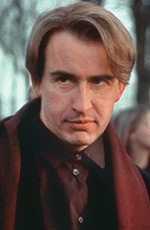
A comic genius


Steve Coogan plays the television journalist-turned-impresario Tony Wilson in Michael Winterbottom's 24 Hour Party People, a movie about the post-punk music scene in Manchester, England and Factory Records, the label that Wilson founded. The style of the movie, which Coogan sort of narrates from his self-serving point of view, is risky but irresistible. He seems to stroll through the late 1970s and 1980s, identifying musical trends as they happen. I didn't know until reading Elvis Mitchell's review ("fact-free fabulous fabulism") that the movie contained cameos by the actual people that Coogan describes.

I don't know why I liked his smug and erudite character so much, except that I kept wishing he had a corollary in the art world.

Tuesday, May 09, 2006

All systems down

I stayed home from work today. Beyond the guilt about calling in sick, I had to miss something that I thought would be a good blog topic: Doug Fishbone's performance at Joe's Pub. Finally something a little different, and I could have shoehorned him into my "Artists I've Known" series. Oh well. He will also screen a number of videos at Freight & Volume on 24th Street in Chelsea on May 13.

I also lost all my art blog links after I took my laptop into the shop (i.e., work) for some upgrades. Now I go to Edward Winkleman and use his links.

Friday, May 05, 2006

Playing hooky at the Met


I took today off and headed uptown to the Met, which is much more civilized on weekdays than on weekends. In such a gargantuan institution, I favor a tripartite approach: See the show that everyone is talking about (AngloMania: Tradition and Transgression in British Fashion); see the show that you really want to see (Kara Walker at the Met: After the Deluge); and choose one wild card (Warriors of the Himalayas: Rediscovering the Arms and Armor of Tibet). Well, that last one was my mother's choice - and it was wild for her.

AngloMania was the weirdest exhibit I've ever seen at the Met, which seemed cool until I remembered that it was sponsored by Burberry and that its opening party was a celebrity-studded outlet for Anna Wintour's ego, according to the New York Times. In English Period rooms, gowns by John Galliano, Vivienne Westwood, and other contemporary design icons mix with more traditional costumes, and the effect is wild, as if some art students had been given the run of the place.

Kara Walker is an artist I first learned about at the Walker Art Center in the 1990s - alongside other black female artists like Carrie Mae Weems and Lorna Simpson. Walker is known for using cut-paper silhouettes, an 18th-century medium, to comment on race. For the Met exhibit, she chose paintings and objects from the museum's collection and combined them with her own work to explore the nightmarish fallout of Hurricane Katrina. I was impressed that the Met even ventured to confront the topic, but I wasn't expecting much. What could she find? Some old paintings of rivers? The little show is a lot more than that, though, especially with Winslow Homer's contribution: It's a reminder that an institution that preserves objects has a lot to teach about any cataclysmic moment in history.

An exhibition of Tibetan armor, helmets, and weapons from the 13th to the 20th centuries is not something I'd typically run out to see; I've found that the arms and armor department of the Met is usually inhabited by fathers and their preteen sons. But the examples of Himalayan ironwork in this show can be appreciated by anyone who is impressed by sheer craftsmanship. Among the usually staid placards, I was surprised to read one that gushed uncharacteristically about a pair of particularly decorative stirrups - and indeed they were stunning stirrups!

Thursday, May 04, 2006

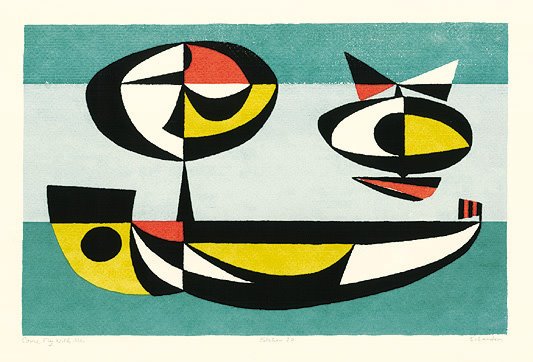
Artists I've known: Edward Landon (1911-1984)


Growing up, my sister and I had to accept the New England temperament of my mother's family, where disputes could rage silently for generations until branches of the family tree eventually dropped off. If the stoicism didn’t scare us, it sometimes prompted gales of laughter and a pact that we’d never act so foolish. But a disposition that valued independence also prized creativity, and my grandparents were surrounded by artistic types who were lured to Vermont by nature and its promise of fulfillment.

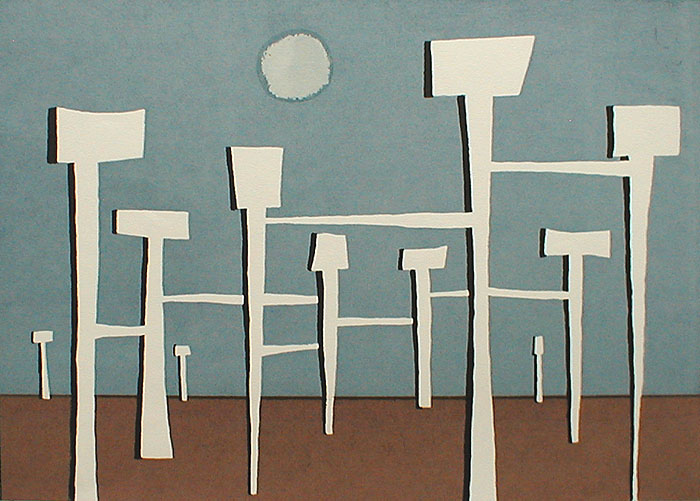
Edward Landon was part of that constellation. Lest you think I’ve abandoned the geographic mandate of this blog, Ed and his wife lived in Greenwich Village until the late 1950s, when they moved to Vermont. Ed started out painting but eventually specialized in silkscreen printmaking, or serigraphy. His work through each decade – from the 1940s until the 1980s – mirrors the major trends of the time, with Arthur Dove and Picasso perhaps his greatest influences. My mother helped him in his studio as a teenager, after an accident rendered him paralyzed from the waist down. Indeed, his wheelchair probably made the biggest impression on me as a kid.

Finding a single print to represent him was difficult, and so I chose Family Tree (1984) because it reminds me of the Vermont landscape and its self-reliant inhabitants, holding each other at arm's length. I happen to have three of Ed's prints; my favorite is At the Gallery (1981), of - what else? - a woman gazing at a painting.

Wednesday, May 03, 2006

Blogger's block


The posts have been few and far between, I know. How do other bloggers do it, what with their daily posts and general ranting and raving. Wait, I know: They don't have to show up at an office every day, stay there for 10 hours, and spend an hour commuting each way. Well, maybe some do, but here's the rub: Blogs are blocked at my office. It's like being marooned on a desert island. Your friends say "Did you see such-and-such on Gawker?" and you're like, "No, I've told you a thousand times that it's blocked." I suppose the policy makes sense, in a totalitarian way. I wouldn't get much done if I had access to blogs all day long.

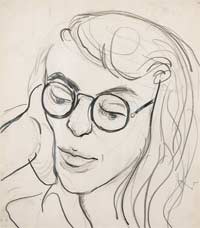
Anyway, I did just have a couple of new ideas. For one thing, I've been wanting to do another installment of my Office Art series ever since I saw some Joan Mitchell prints (see her self-portrait above) on the other side of my floor. Yet another tragic placement of very large prints along a narrow, poorly lit hallway - guaranteeing that no one will really see them, let alone appreciate them.

But I am more excited about another idea. I am going to highlight some artists I know - or in some cases have known, for they are no longer with us. It's only a tiny handful, so it shouldn't take long to run through them. More to come...

Friday, April 28, 2006

Off the beaten path on West 27th Street


West 27th Street between 11th and 12th Avenues is a quiet, cobblestone street, free of the glossy commercial storefronts and strip clubs that have made surrounding blocks a major destination. Walking west, into the setting sun, it was easy to imagine the street in another era, warehouses and loading docks in full operation. The galleries here, situated only on the north side of the street, are smaller and more intimate, and have been here for only a few months. I visited three on Thursday evening - Plus Ultra Gallery (No. 637), Wallspace (No. 619), and Foxy Production (No. 617).

Plus Ultra Gallery is presenting an exhibition of miniature sculptures by Joe Fig, who portrays well-known artists in their studios. The exhibition’s centerpiece is a detailed replica of the Long Island studios of married artists Eric Fischl and April Gornik, filled with works in progress. Also on view are tiny recreations of contemporary artists’ painting tables, covered with their materials and tools. Beyond the marvel of such scrupulous reproductions, and their whiff of compulsion, is the question of why a young artist would undertake such a documentary-like project. The sculptures certainly form a record (they incorporate taped interviews with the artists), even a voyeuristic one, and they seem to be an homage; an older artist executing a similar project might come off as disgruntled.

Helen Verhoeven’s lush paintings at Wallspace reminded me of Edvard Munch, or perhaps he’s just very much on the mind these days. Born in the Netherlands, Verhoeven seems to tread the same psychological territory; her depictions of figures and interiors have a creepy quality, even when the subject seems banal. They seem remembered instead of observed, as if through the filter of a bad dream.

Michael Bell-Smith, at Foxy Production, is the first artist I’ve seen who convincingly uses digital imagery to examine and comment on its role in contemporary culture. And guess what: He has a blog!

Monday, April 24, 2006

Blind Spot benefit auction


Tonight's auction at Phillips de Pury & Company benefits Photo-Based Art, the non-profit organization associated with the photography magazine Blind Spot.

I couldn't stay for the entire auction, but I saw about half. Unfortunately, most of the works sold below their estimates.

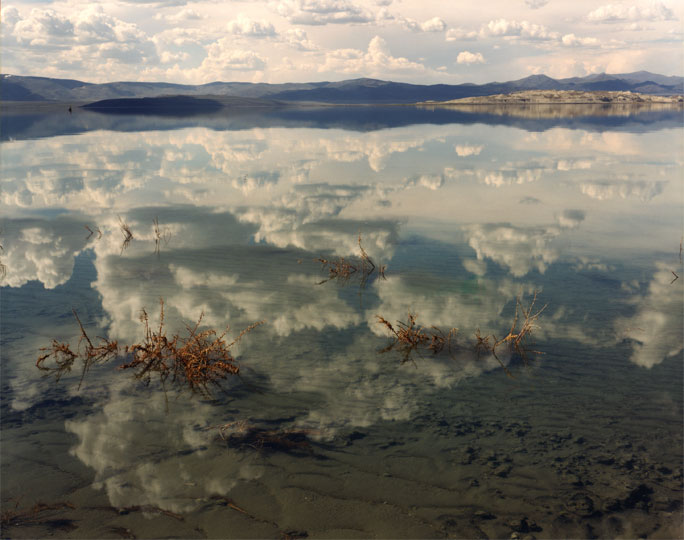
One solid exception was Richard Misrach (American, b. 1949), Mono Lake #2, California - (negative) 1999, (print) 2005, 30 x 37 inches, which was estimated at $7,000-8,000. It sold for $10,000.

Friday, April 21, 2006

Weekend art links


Holland Cotter defends midcareer artists.

Art fairs steal the show from the auction houses, as some dealers exploit them to great effect.

For many artists, a 451-mile-long security barrier snaking through the West Bank has become the world's most inviting canvas.

On anonymity

I hate anonymity, and couldn't agree more with all the critics of anonymous blogs. Unsigned information has no credibility, a lesson taught most eloquently by information design guru and Yale professor Edward Tufte. Until I leave the financial services industry, however, I'm planning to stick with Porcupine.

Thursday, April 20, 2006

A look at which of today's young photographers might endure


reGeneration: 50 Photographers of Tomorrow is on view at the Aperture Gallery in Chelsea. The exhibition was organized by the Musée de l’Elysée in Lausanne, Switzerland, and aims to highlight not just the best young photographers coming out of the world’s top schools, but the most durable. The show is global in a truly 21st-century sense; just when you expect to find certain cultural conventions, borders slip away from you - most artists these days seem to be born in one place and living (and working) somewhere else.

Four of the artists participated in a panel discussion tonight - Chih-Chien Wang, Angela Strassheim, Josef Schulz, and Shigeru Takato.

Chih-Chien Wang is a native of Taiwan but lives in Montreal. His interest in photography grew out of filmmaking, and it’s easy to see how he has used it to examine his life as an outsider. His photographs – of himself, his girlfriend, and things in his apartment - are quietly clinical and insular.

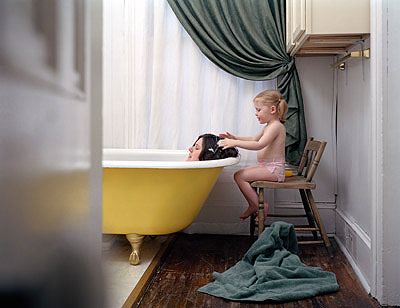
Angela Strassheim (above) was the most interesting speaker for me. She is close to my age and went to college in Minneapolis, and I especially liked her photographs at the Whitney Biennial (see my earlier post). Once a forensic photographer for a city morgue, she has turned her eye on families and especially on young women who, as she says, are undergoing transformation. If there is such a thing as a feminine sensibility in art, I would venture to say that it can be found in her observations of family rituals and their replication in successive generations.

Shigeru Takato’s photographs of television studios around the world are exuberant affirmations of the powerful role of the media. The images register as otherworldly, with a flavor of science fiction. He describes TV stations as pockets of human emotional energy, sending out rays that reach beyond the planet and into outer space.

Monday, April 17, 2006

'A hunting sport'

"Though the conventional image of an artist's mentor is not generally a venture capitalist, such a presence is not so surprising in an era when collectors from Wall Street are underwriting high prices for contemporary art." Warhols of Tomorrow Are Dealers' Quarry Today (April 15)

Sorry I missed this in the New York Times, since I blogged about it on April 12.

Sunday, April 16, 2006

LOT 85 - Ham Jin


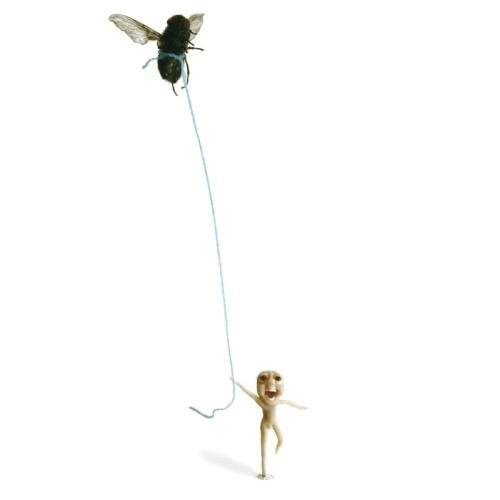
Thanks to BB for pointing out the brilliance of this miniature masterpiece, the weird and wonderful Boy Flying a Fly, which sold at the Contemporary Art Asia: China Japan Korea auction at Sotheby's on 31 March 2006.

Saturday, April 15, 2006

A Journey That Wasn't, at the Whitney Biennial


If things don’t work out between Matthew Barney and Björk, artistically or otherwise, I have a suggested replacement - French artist Pierre Huyghe (for either one of them). He certainly shares their interest in journeys by boat to faraway places.

I stopped by the Whitney Museum today for a second look at the Biennial because I missed Pierre Huyghe's film on my first visit. I don’t know how – it was right there on the first floor, to the left of the elevators. I worked at the Whitney back in 1993, during the infamous 1993 Whitney Biennial. Thirteen years later, I still recognize the security guards and the elderly volunteers at the membership desk. (Rumor had it that the security guards, who belong to a union, earned more than the curators.) When I learned that the receptionist for the administrative offices had a Master’s degree in art history, I more or less gave up on a career in the arts.

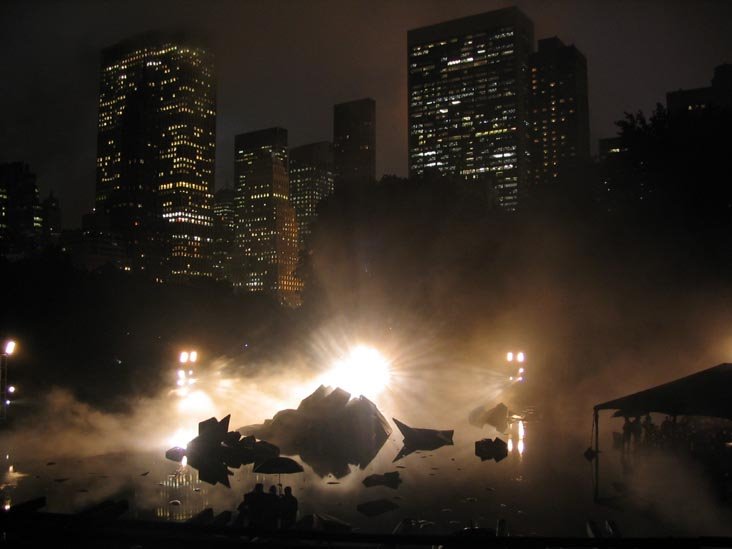
A Journey That Wasn't was filmed in two parts – one in Antarctica, where Huyghe chartered a boat to find a remote island and the solitary albino penguin, and one in Central Park, where he recreated the Antarctica trip at Wollman Rink. This description sounds strange, but it seemed to make perfect sense when I saw it. The two parts are intercut to the accompaniment of a symphonic orchestra, and the effect is romantic and ominous. The polar landscape is stunning and forbidding, and yet the trip’s retelling, against a Manhattan backdrop and with an audience, seems equally menacing. The Central Park performance, in turn, makes Antarctica seem like a theater, a stage for the penguins and the intrepid human travelers.

Friday, April 14, 2006

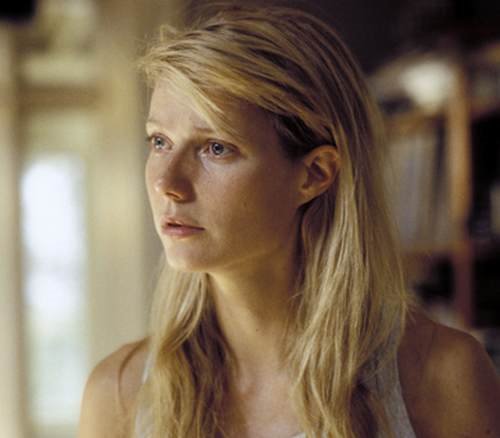
Math geeks never looked so good - Proof


Proof is based on David Auburn's prize-winning play of the same name - one of the few plays I’ve seen on Broadway. It stars the fair Gwyneth Paltrow as the daughter of a famous dead mathematician, who is played in flashbacks by Anthony Hopkins.

The “proof” of the title is a mathematical theorem that Paltrow’s character (Catherine) may or may not have written, but there is also the question of proving whether she wrote it. Catherine is either a genius or she is slowly going mad, as her father did at her age. Either possibility is alluring, particularly to a student of her father's played by a scruffy and sincere Jake Gyllenhaal. (Years ago a friend of mine suggested that we might try to meet nice, smart boys by hanging out in the math department at Columbia University; if any of them looked like Jake Gyllenhaal, she may have been on to something.)

Catherine fits squarely in the tradition of great misunderstood artists, which is why she gets away with her volatile behavior. The story is a psychological mystery played out in flashbacks, but its various strands – the chronicle of a gifted child, the process of grieving for a deceased parent, the burden of a parent’s legacy, the dynamics of sibling relationships – never really develop.

Thursday, April 13, 2006

Glad we could help department (Tara Donovan)


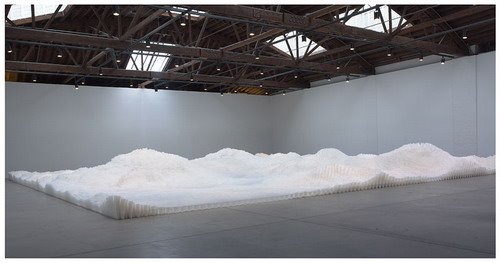
Tara Donovan’s show at PaceWildenstein, a large-scale installation of plastic cups resembling a topographical landscape, has received a lot of praise. I liked it on several levels – the sprawling scale, the element of surprise when you realize it is made up of millions of cups, the play of light. But I was curious to find out what the critics would say about something that pleases on a rather visceral level, and I think I’ve found a good example:

"Tara Donovan’s art is phenomenological [phe·nom·e·nol·o·gy: the study of the development of human consciousness and self-awareness as a preface to philosophy or a part of philosophy] in the sense that her “site responsive” [why the quotes?] sculptures reveal the purely subjective aspects of consciousness. The vacillation between illusion and material reality prevalent in her work activates perceptual shifts [Is it a bunch of cups? Is it a landscape?]. So rather than say Donovan’s “Untitled (Plastic Cups),” (2006) doesn’t work [who said it doesn’t work?] because the raw material (plastic cups) isn’t completely transformed or because we have seen this sort of thing before, we should focus on the dissociation that takes place [OK. Focusing now]. Tara Donovan’s work creates a dramatic tension between what cognitive neuroscientist Uri Hasson [here we go with the experts] calls “activation induced by local object features and activation induced by holistic, grouping processes that involve the entire object or large parts of it.” [Interesting point. What does Hasson think about the show?] Donovan would have prevented viewers from seeing her artworks close up if she wanted to conceal the individual units that comprise the whole [I don’t think there’s any question that she wants us to see the cups]. The work currently on display at PaceWildenstein is a complex version of the vase-face illusion [the who-what illusion?]. It contains an inherent contradiction in the sense that its physicality immediately inspires neuronal activation that is not dependent upon the physical properties of the visual stimulus [it makes me think I am looking at the surface of the moon and not at some cups]. It works because both ends of the spectrum, the material reality of the stacked cups and the illusion of a natural or extraterrestrial landscape, absorb our attention [that is, it is satisfying to look at, whether it’s a bunch of cups or a landscape]."

Is that clear? Good.

Yes, we have no memorial


"Eh, excuse me," a man says to me in a European accent, "Ground Zeh-ro?" We are on Vesey Street.

"It's right there," I answer, pointing behind him, "you've passed it."

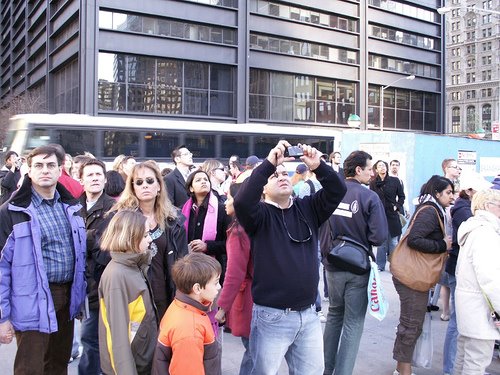
For anyone living in New York who doesn't know, tourists descend upon the former site of the World Trade Center each day in droves. Indeed, they now arrive by tour bus and swarm out onto Church Street, perhaps around to Vesey or Liberty, or if they are really adventurous, over to the World Financial Center, for a view from the Winter Garden. They cluster around the metal barrier that forms the perimeter of the site, trying to take pictures through its grid. And they point.

At what? There is nothing to see. A construction site, a lot of vehicles, but not a lot of activity. What do they expect to see? Most of them never even saw the World Trade Center, so what does its absence mean to them? A couple of vendors sell cheap souvenirs with garish photos of the attacks, emblazoned with the word "TRAGEDY" in block letters, along with counterfeit FDNY baseball caps.

And so the tourists shuffle around, the office workers race past, the construction workers hold up the backdrop, and that is where we are four and a half years later.

Wednesday, April 12, 2006

Matthew Barney’s drawings


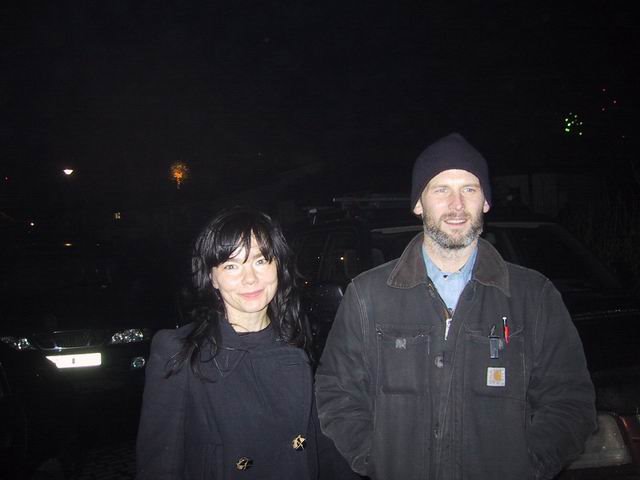
Matthew Barney’s The Occidental Guest is on view at the Gladstone Gallery in Chelsea in conjunction with the film Drawing Restraint 9. The film is the first to feature Barney with his partner, the musician Björk, who also scored the film.

Five or six years ago, the news that Matthew Barney and Björk were a couple struck the art world as the incarnation of a peculiar form of creativity; it seemed as if the two couldn’t have been better matched. Both artists have continually transformed themselves - Barney in his cool, conceptual sculptures and performances and Björk in her lush and experimental music - and both have cult followings.

The exhibition I saw today is like a visit to Barney’s mind, albeit with restricted access. I haven’t seen the film yet, but I’ve read enough to appreciate the references to a whaling vessel in the sculptures (or “models”) on display. But it was the feathery drawings that I found most amazing. They intimately relate his ideas about physical limitation and chart a course that lends logic to his imagery.

The next big thing

Are young artists being flogged like Internet stocks in the late 1990s?

A discussion on Edward Winkleman has me wondering about the apparent obsession with youth among today's collectors. Does youth signify limitless potential, the chance to get in on the ground floor, much like venture capitalists? After all, older artists have had a chance to prove themselves and may have reached a sort of stasis.

Tuesday, April 11, 2006

Apres Vous, in which men try to help each other


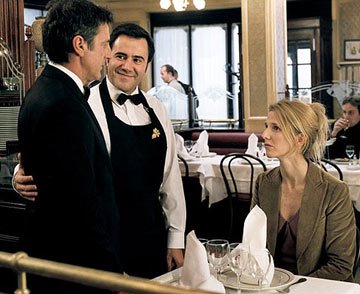
One more French movie tonight and then I'm going back to American movies - Apres Vous (2005), in which Daniel Auteuil plays a restaurant manager who saves a stranger from killing himself, and proceeds to try to fix everything in the man's life.

The movie could have been a great black comedy, but fell apart when Auteuil's character tried to resuscitate the man's love life. It also could have been a funny exploration of a codependent friendship between two straight men, with one meddling like an old lady in the other one's life, but it didn't work on that level either.

Monday, April 10, 2006

Un Air De Famille


"All I know is that a man's a man and a woman's a woman."

Un Air De Famille (1996) hopefully satisfies my obsession with Agnès Jaoui for a while.

A family gathers to celebrate a birthday, and the tension is excruciating: the mother yammers unhelpfully, the siblings are absorbed by their disappointments, and the daughter-in-law weeps.

Keep those apéritifs coming!

Saturday, April 08, 2006

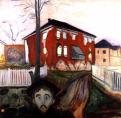
Edvard Munch - Under a blood-red sky


Edvard Munch: The Modern Life of the Soul is at MoMA through May 8. It's a curious title - the modern life of the soul? (As opposed to its traditional life?) But 100 years later, Munch’s view remains the modern view.

The exhibition "charts Munch’s move away from Norwegian naturalism toward an unprecedented exploration of modern existential experience." The experience he explores, of course, is full of anguish and despair.

The best way to appreciate this exploration is to focus on his self-portraits as he ages. From a young and cocky bohemian smoking a cigarette, his figure dissolving into loose brushwork, to an increasingly tortured loner, the weight of his environment pressing in on him, Munch’s gaze seems to drill into the soul. The effect is gut-wrenching: hollow eyes that have seen death and madness, mouth turned down, arms hanging limply.

Friday, April 07, 2006

Luisa Lambri and Trading Spouses


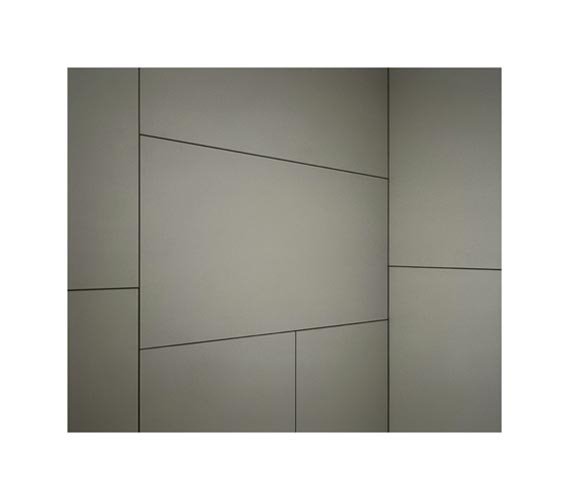
Luhring Augustine is showing the work of Italian photographer Luisa Lambri. Lambri photographs the interiors of notable modern buildings, and the result is inevitably minimalist. The spaces are always empty, but they are not perfect, as depicted in sleek commercial photography; instead, they bear traces of wear. Some are overly suffused with light, like those scenes in movies that are meant to presage death. Many are of half-closed shutters that reveal tantalizing views outside. But if these photographs are supposed to evoke her personal relationship with these spaces, they don’t work. There is not enough in them - no narrative and no feeling. And because they are not formally complex, there is not enough to captivate the viewer.

Tonight I also saw an episode of Trading Spouses on Fox. What does this have to do with art? Not a single thing, but someone in my office knew one of the spouses. The premise of the show is simple: Two wives change places and hilarity ensues. But this wasn’t the typical switch, such as a white-trash housewife with an ambitious go-getter. The families were both accomplished, affluent, and intellectually equivalent.

The Plonskers are a serious, goal-driven family and the Welsh’s are a fun-loving British family. But Patty and Jeff Plonsker spend all their time working and financing an upscale urban lifestyle, while Sheila and Barry Welsh find time to horse around with their sons. Patty finds the brash Barry (a rocket scientist) rude and out of control; she herself employs an etiquette coach for her family. But her own husband Jeff, who dyes his hair and adds “ster” to everyone’s name, takes calls on his cell phone during family dinners. Meanwhile, unaccustomed to housekeepers, British Sheila feels like the Plonskers’ maid, and bristles when Jeff ignores his children.

The Plonskers are consumed with aspiration; the Welsh’s like to go wild. The Plonskers want to impress with their material possessions (and Sheila sees through it); the Welsh’s want to seduce with their antics (Patty gets drunk on champagne on her first day). The show isn't over, but I'm already impressed: First, that these families would go on a reality TV show, and second, that Fox paired them.

Friday art link

The Walker Art Center has blogs!

Thursday, April 06, 2006

Enron's synergistic corruption

"When Jeff Skilling got Lasik on his eyes, everyone at Enron got Lasik."

I mixed up the dates for the Matthew Barney show at Barbara Gladstone, so instead I watched Enron: The Smartest Guys in the Room. The 2005 documentary tells an absorbing tale of "synergistic corruption," full of damning footage and memorable quotes. Most interesting is the characterization of Ken Lay and Jeff Skilling as former nerds who made it big. But they don't compare with Lou Pai, former head of Enron Energy Services, who left Enron with more money than anyone because he sold all his stock after he divorced his wife to marry his stripper girlfriend who was having his child. (See, I don't remember this particular detail being on the news.) This passage is helpfully supplemented with generous footage of strippers in nightclubs.

That's probably the best part about the documentary, apart from the music; when the footage runs low, there's lots of skydivers and daredevils falling through the air.

Wednesday, April 05, 2006

Movies I am watching


NetFlix has changed my movie-going habits; namely, I don't "go" to any movies. Instead I sit at home and they come to me, and I can indulge any whim I may have. So far I have managed to watch every episode of Absolutely Fabulous ever made, every Hayao Miyazaki movie available here, some depressing Danish movies, and a whole lot of garbage.

Lately, though, I've been watching a lot of foreign relationship movies. This week was Eros (2004) - Wong Kar-Wai, Steven Soderbergh, and Michelangelo Antonioni - and 5X2 (2005) - directed by François Ozon, in which a deteriorating marriage is chronicled in reverse, from divorce to cavorting on an Italian beach.

Saturday, April 01, 2006

Blogs are the new 'zines


I was reading The L Magazine, a nifty little giveaway weekly, on the N train. (Someone is spending a serious amount of time editing it.) Something in the magazine reminded me of 'zines in the 1990s, and how I wanted to start one when I lived in Minneapolis and spent an inordinate amount of time in coffee shops, in between my five part-time jobs, and how now I sort of have one.

I didn't go to any art shows today because I went to hear a band instead. They are known as Felix Unger for reasons unknown to me, and they played their second show ever today at Cake Shop (152 Ludlow Street). Because I don't wander around the Lower East Side as much as I'd like, I decided to check out all the food places that I've read about on one of my favorite blogs, The Girl Who Ate Everything. I went to BabyCakes, Tiny’s Giant Sandwich Shop, and Sugar Sweet Sunshine (I had the Ooey Gooey - chocolate cake with chocolate almond buttercream). What a cute area - I am sure it will morph into a mall (yes kids, here I go again). I have to admit that this excursion was more fun than some of the art shows I've been going to, but maybe my luck will change.

(And a sidenote: What is the story with 190 Bowery? A gorgeous 1900 building on the corner of Spring Street that looks completely derelict. How could this be? Why has Vornado not turned it into a mall?)

In the meantime, I might try to emulate the spirit of 'zines, though I could use the help of Minnesota's own Dunn Brothers!

(Another sidenote: I just read the History page on the Dunn Brothers Web site. Apparently the founder chose the Twin Cities area because it has "a large coffee drinking population and a prolonged hot coffee drinking season." Hmmm. Minnesota = cold, coffee = hot. See, this is the kind of reductive business model that even I can understand.)

Friday, March 31, 2006

Friday art link

In the art world, there’s a clear delineation between those who experienced the last crash, in the early nineties, and those who didn’t.

Wednesday, March 29, 2006

Downtown, 1974-84


I waited until the last minute to see The Downtown Show at New York University's Grey Art Gallery. What a mistake! This messy and raucous show, which examines the artists who were active in Lower Manhattan from 1974 to 1984, is brilliant. I say messy because it is organized around some oddball themes, but how else can a curator accommodate a range of artists like Ida Applebroog, Chuck Close, Nan Goldin, Robert Mapplethorpe, and David Wojnarowicz - and those are just some of the bigger names.

The show is a crazy collection of drawings, paintings, photography, video (which lends a soundtrack), sketchbooks, letters and other printed matter that call to mind a period in art and in New York that continues to influence artists today. Kenny Scharf's cartoon paintings are still imitated by young artists. Ann Magnuson's impact is still felt on performance art and comedy. And the list goes on.

But mostly the show brought back memories of being a teenager in New York in the 1980s. In 1984, I entered high school. It was an art school - the "Fame" school! And boy, did we think we were cool. We bought our clothes at vintage stores and wore leopard-print bathrobes to class, where no one batted an eye and the grizzled art teachers were happy for their jobs. We copied paintings at the Met and made friends with the security guards, most of whom were artists. And, of course, we spent an enormous amount of time downtown - when the Bowery was still scary and Union Square Park was still off limits (that is, for good kids who spent most of their time studying for their AP exams). We ate $3 Indian lunches, drank coffee in Italian cafes, obsessed about Comme des Garcons and the Pet Shop Boys. But along the way, we saw Anselm Kiefer's first show in New York and ate at what must have been the first trendy restaurant in SoHo (I'm sure someone will dispute my claim, but it was cafeteria-style and I always had the Brie and avocado on a baguette).

New York was so different then. (Hey kids, are you listening?!? It wasn't all about money!) I'm sure it wasn't any easier for artists, but there were scrappy places like ABC No Rio and the barriers to entry didn't seem quite so high. Not that anyone from my high school ever made it big - with the exception of Jennifer Aniston.

Sunday, March 26, 2006

David Smith and all that steel


Sometimes I go to see something and I have no reaction whatsoever. So it doesn't end up on the blog. But that means I don't get to boast about everything I have seen. So I am creating a retroactive note to say yes, I did see the David Smith centennial at the Guggenheim on Sunday. Lots of welded steel and machismo.

David Smith is one of those artists that you cannot appreciate unless you picture America in his heyday, the 1950s and 60s. This reminds me of a photograph I once saw of an exhibition of Picasso's paintings. In the photograph, his familiar paintings were surrounded by people dressed in the clothes of the day (I think the women were even wearing gloves!), with 1930s-era cars passing by outside. Nothing could ever drive home the point more effectively - these artists were seen as lunatics in their time.

Speaking of Picasso (and since this is turning into a stream of consciousness), this reminds me of the time I picked up an art survey book (probably Gardner's) belonging to my grandmother, which must have been published in the 1950s or so. It ended with Picasso, and dismissed him as an upstart whose work would never endure.

Saturday, March 25, 2006

Nan Goldin's eulogy


Nan Goldin: Chasing a Ghost, at Matthew Marks, features a three-screen projection that explores the institutionalization and suicide of the artist’s older sister Barbara. Entitled Sisters, Saints, & Sibyls, the multimedia installation begins with the story of the third-century Saint Barbara, who was imprisoned by her father in a tower and later murdered by him. The legend, often depicted in painting and sculpture, serves as an allegory for her martyred sister, and imbues the subsequent narrative with heroism.

'I hurt myself today, to see if I still feel'
Goldin narrates the 40-minute projection in her own words. Her prose is plain, but she uses music to great effect, and the result is very moving. (I could listen to that Johnny Cash song 100 times.) Goldin recounts her sister's short life (she lived to be nineteen) with family snapshots and more recent photographs - of a psychiatric institution, the train tracks where she died, and her gravestone. The images don't actually betray her sister's suffering - indeed, it's not even clear why there was so much discord between Barbara and her parents - but we imagine it, and it is crushing.

Goldin's narrative then shifts to her own life - how she grew up expecting the same fate, how she sought out an alternative family, and how she turned to drugs. Seen from this perspective, her life story becomes an inevitable struggle with addiction and even self-mutilation. There is little redemption in the story, save for Goldin's tender portrayal of her aging parents. And that is the point, finally: The photographs in the exhibition, by turns steady and wavering, convey an odyssey of guilt, horror, and pain, and then return to the parents.

Friday, March 24, 2006

Friday art links


The role of water in the history of black people in America - Kara Walker at the Met.

The online fallout from The New Yorker's March 20 profile of Sotheby’s auctioneer and tastemaker Tobias Meyer.

Charlotta Westergren’s renditions of paintings made by her older sister - at Bellwether.

Monday, March 20, 2006

Heike Liss and a lack of belonging


Thursday night was overshadowed by the gala opening for Made in Palestine (see my earlier post), but I did see some other shows that night. One that ties in well with the Palestinian show is home/away, by Heike Liss, at the CUE Art Foundation.

The color photographs by this German artist are portraits of forgettable places, and were taken in the course of her travels. Her artist’s statement reads “home/away asks to what extent do we define ourselves in relation to ‘home’; the work examines what that definition means in a world where so many individuals do not live where they were born.”

Wow. Now, even an art history professor couldn’t have stumbled on a more fortuitous correlation with the Palestine show and its theme of displacement. The idea of home, especially for those of us who live quite a distance from where we were born, is endlessly interesting. Why? Because when you have to recreate your home in a different country, you are continually approximating and adjusting. Nothing escapes examination. And the smallest details count. Liss focuses on those banal details as if to commit them to memory – as if to say, you don’t have to fixate on them, I’ve recorded them.

Saturday, March 18, 2006

Islamic art by any other name


Without Boundary: Seventeen Ways of Looking, at the Museum of Modern Art, has a weak curatorial premise but some of the most stunning work I've seen recently. It purports to examine the term "Islamic art" and its applicability, but only succeeds in reinforcing stereotypes (more calligraphy, more keffiyehs, and more veils). "The show doesn't reveal anything substantive about Islamic culture. Rather, it presents the distinctive vision of highly Westernized émigrés," to quote a comprehensive review by Lee Siegel on Slate.

I can hardly add to the points made by Siegel. But what can I say? Mona Hatoum (who is actually Christian), Shirin Neshat (above), Shahzia Sikander, and Bill Viola (one of two Americans in the show) - these are some of my favorite artists, and they are represented here by some real gems. Emily Jacir was a new name to me, but it turns out she was in the original Made in Palestine exhibition (see my earlier post). Oddly fascinating was her two-part video Ramallah/New York, which shows images of daily life in each location side by side - a real-time illustration of how immigrants recreate their former lives in new settings. And guess who else makes an appearance - the Lebanese artist (and charlatan archivist) Walid Raad (see my February 28 post).

The show succeeds because of the quality of the work. But the accompanying text is confusing and contradictory - more curatorial gymnastics than guiding principle. According to MoMA, "The exhibition seeks to emphasize diversity by questioning the use of artists’ origins as the sole determining factor in the consideration of their art." But it doesn't question origin this way. And an ongoing conceit about the art defying expectations loses meaning when you try to pinpoint exactly what those expectations would be.

All artists draw on their heritage to some extent, but only a small number share a heritage that is in the headlines. I'd like to see what MoMA would do with an exhibition of artists from Ohio - talk about an "unexamined rubric"!

The Palestinians are coming


Made in Palestine, the first exhibition of contemporary Palestinian art in the U.S., is on view at the Bridge, 521 West 26th Street, through April 22. I went to the raucous opening on Thursday night and returned for the artists' panel on Friday night.

Made in Palestine is a curious throwback to the political and identity art of the mid-1990s. The original show was organized in Houston, which is home to some 25,000 Palestinians, in response to 9/11, and was double the size of the New York show. The exhibition has generated controversy - its name alone will make some people bristle - particularly when curator James Harithas tried to move it to another city.

The work itself is quite varied, and not surprisingly, the most overtly political pieces tend to attract the most attention. One example is A Time to Cast Stones, an ammunition box that contains stones, by Rajie Cook. A former graphic designer and the son of Palestinian parents, Cook uses stones, keys, and keffiyehs as visual shorthand for the Palestinian struggle. As you might expect from someone who spent his career in advertising and corporate communications, each of his pieces packs an immediate message, and so he could be called the most activist of the artists on view.

By contrast, Samia Halaby's abstract paintings are inspired by nature and are more a product of her training - she studied art in the U.S. - and her influences. For me, this was a truer glimpse of Palestinian art; although Halaby has spent much of her career promoting Palestinian art, she is more interested in the conditions under which it is created than with communicating a specific message.

John Halaka, an American of Egyptian descent, struggles with the diaspora of the Palestinian people from a distance. His drawings and paintings rely on figurative metaphors for displacement and instability.

Mary Tuma, another American of Palestinian descent, is interested in the experience of women. Her long black dresses, suspended from the ceiling and trailing on the floor in a funereal procession, are one of the highlights of the show.

Friday, March 17, 2006

Friday art links


The trouble with most paintings of nudes is that there isn’t enough nudity.

At MoMA, Without Boundary: Seventeen Ways of Looking "seeks to emphasize diversity by questioning the use of artists’ origins as the sole determining factor in the consideration of their art."

At International Center of Photography, Snap Judgments: New Positions in Contemporary African Photography "forces a recognition of the contradictory and varied forms of photographic practice that are now arising across Africa."

Sunday, March 12, 2006

Pardon?

Hovering between and adding an ironic twist to the two notions that for centuries have determined artistic and philosophic quarrels—form and content—this exhibition features works by ten New York–based emerging artists concerned with the unresolved relationship between visible appearance and invisible essence.
- Artforum

Williamsburg, and not going home again


On Saturday night, I headed to Brooklyn to check out the galleries in Williamsburg. They had organized an After Hours event for Armory Show weekend, and were staying open until 11 pm.

Taking the L train there involved some measure of nostalgia, because I lived in the area roughly ten years ago. Wandering east and then south, I set foot in a number of galleries, but despaired of finding anything to write about. More interesting was how much the landscape had changed: A yoga studio on North 7th Street? A tattoo gallery on Roebling? Cleverly designed restaurants and boutiques on Grand? It felt like Berkeley or Northampton.

Gentrification is a tiresome topic, but it's hard to visit the galleries scattered north and east of the Williamsburg Bridge without thinking about it. Yes, there are artists who have lived in Williamsburg for some time, like the friendly proprietress of Holland Tunnel, on South 3rd Street, who told me she started her tiny gallery in a garden shed in 1997. But like a college town, it has a quality of ambitious people just passing through, underscored by the businesses that cater to them. (And the babies being toted along to gallery openings don't contribute to a sense of permanence; I don't imagine many of them will one day enroll in the local public school.)

Out of the roughly ten galleries I visited, I'll mention just three: Black & White, Jack the Pelican Presents, and the Sarah Bowen Gallery.

Black & White Gallery is showing large paintings by German artist Ina Geissler in its indoor gallery. Colorful and technically proficient, they seem to depict elements of modern architecture - minus the structural engineer. More faithful to physics is the model of a house in the outdoor gallery, installed by Peter Franck and Kathleen Triem.

At the Sarah Bowen Gallery, Yumi Janairo Roth presents police barriers that are covered with mirrors, like a disco ball, and wooden pallets carved with an elaborate decorative motif.

Jack the Pelican Presents was like a shot of testosterone compared with everything else I saw - in terms of both the art and the atmosphere. War is the general theme for Guerra de la Paz (Cuban artists Alain Guerra and Neraldo de la Paz), along with gay sex in the military, vivid brutality, and general degradation. Among the sculptures and videos are two soldiers posed in the manner of Michelangelo's Pietà, and a group of children dressed in camouflage holding hands and circling a bomb.

[Saturday footnote: Slobodan Milosevic is found dead in his cell.]

Thursday, March 09, 2006

Office art II - Milton Resnik


The second installment in our Office Art series examines a set of prints by Milton Resnik, an abstract expressionist who died in 2004. He is remembered as the last major painter of the original New York School and as a teacher, and for that we salute him.

Three untitled monoprints from 1982 hang along a narrow hallway. The prints share an underlying abstract image, which I think began as a lithograph, but each one is slightly different in color and texture. They are rather dark to begin with, but they also suffer from poor lighting and reflective glass that renders them invisible. Sadly, I suspect that no one pays much attention to them, and so we give them a rating of B.

Resnik seems to have been bypassed by the paper of record, as well: He is mentioned in a 1996 New York Times art review of Pat Passlof - he was her husband.

Office art three-point rating system

Today I decided that the Office Art series will be meaningless without some qualitative analysis. To that end, I have developed a simple, three-point rating scale:

A: Not bad - really brightens up the place;
B: Never noticed it before; and
C: On top of going to work, I also have to look at that?

I will now go back and give Richard Smith his due.

Wednesday, March 08, 2006

Office art I - Richard Smith


In the first installment of our Office Art series, we take a look at Large Red, by Richard Smith, a monochromatic etching from 1976. If you look closely, you'll see two parallelograms sort of floating at an angle.

After performing some research (ahem, Googling), we learn that Richard Smith is British and was born in 1931. He taught at various universities, and in 1976, he settled in New York. He even has an artist's statement:

By depicting everyday interior environment and some of the routines, rituals, scenarios and happenings that occur, or may occur in these spaces, I hope to place things often taken for granted in circumstances that focus our attention on them; often to consider their vulnerabilities.

My abstraction of form and colour is used to emphasize the real and imagined effect of light and draw attention to specific areas of the painting. The intensity of colour used is also for these aims, as well as its seductive qualities. The compositions in my paintings are intended to create a state of tension.

Well, there you have it. Richard Smith, we give you the highest honor in our proprietary three-point rating system - A: Not bad - really brightens up the place.

The Porcupine takes on office art

It occurred to me the other day, as I was standing around at work, chatting with Pinky, that I don't need to go to galleries or museums for material to write about, when art is all around us. It's on every floor, in every hallway, and near every elevator. Yes, it's time to finally examine office art.

At first, I was concerned that documenting this aspect of my office would compromise its anonymity here. But then I looked around again at the bland walls and decided, who am I kidding? This place is unidentifiable. (A European concern might actually spend a couple of bucks on interior design. But not here. They just replaced the 1980s-era carpeting. Which was green.)

And so, this will be a series of posts about any piece of art that I think has something to say, even if it says more about the art buyer's budget than anything else (think lots of prints). Pinky claims that a certain downtown firm owns (and displays) something by Jeff Koons, which strikes me as an instance of corporate ballsiness that borders on the mythological, so I am hoping for photographic evidence.

Tuesday, March 07, 2006

Telling the story of creativity with puppets - Pierre Huyghe at the Marian Goodman Gallery


Tonight I went to the opening for French artist Pierre Huyghe's 2004 film This Is Not a Time for Dreaming, at the Marian Goodman Gallery on 57th Street.

I first saw Pierre Huyghe (Hue-wee) in 2003 at the Guggenheim Museum, in an installation that featured a film and a sculpture. The film showed two buildings enveloped in fog, and I remember thinking that it was beautiful and moody, the passage of time marked by lights flickering on and off in the windows. The buildings were apparently 1970s French housing projects. To quote from the Guggenheim's exhibition literature, "'These subsidized public projects ended up being an architectural and social failure,' explains Huyghe. 'They were a corruption of Le Corbusier's social and architectural Modernist theory.'"

In 2005, of course, riots broke out in these housing projects.

Morning Edition, November 30, 2005 · Some analysts blame recent rioting in France on the discontent and alienation fostered by bleak housing projects on the poor outskirts of French cities. The location and architecture of public housing can contribute to a sense of isolation and hopelessness among young French people of Arabic and African origin.

Le Corbusier was the forefather of the modern high-rise, low-income apartment complex, and he is an abiding interest of Huyghe's. This Is Not a Time for Dreaming is a 24-minute film based on a puppet musical, and it explores the creation of architect Le Corbusier's only building in North America, The Carpenter Center for the Visual Arts at Harvard University.

Sunday, March 05, 2006

Collecting thoughts about collectives

Holland Cotter's The Collective Conscious in Sunday's New York Times is about the increasing visibility of art collectives, which have become a major theme of the 2006 Whitney Biennial. I can't resist posting the opening here:

Contemporary art is a multibillion-dollar global industry. But why does such a big deal look so small, so slight, with its bland paintings, self-regarding videos, artful tchotchkes and shoppable M.F.A. artists-to-watch? There has to be another way to go, an alternative to a used-up "alternative." By far the most interesting option ... is the work of miniature subcultures known as collectives.

I mention the article because it made a passing reference to the Lebanese artist Walid Raad and his so-called Atlas Group (see my February 28 post "Chronicling the car bombs of Lebanon" and Jerry Saltz's take in the Village Voice). Raad refers to the Atlas Group as a foundation, an organizing principle, and an archive - and in that sense, it fits Cotter's definition of collectives that "stretch conventional definitions of art and artist ... into the realm of activist politics, scientific experimentation and historical reclamation."

In Raad's case, I tend to think that the genesis must have been fairly simple: Isn't it easier, when collecting data from government sources, to identify yourself as part of a group - particularly one with such a benign name and no identifiable religious association? I wish I had asked him.

Saturday, March 04, 2006

The Whitney Biennial - New York's toughest docent gig


"This is faaabulous!"
"It's all garbage."

I heard both of these comments, just minutes apart, while standing on the fourth floor of the Whitney Museum. And that pretty much sums up the 2006 Whitney Biennial. I walked slowly through every floor and dutifully tagged along on a tour of the third floor. The docent did an excellent job, but I lost count of the number of times she said "This raises all kinds of questions about... [insert vague postmodern conceit - more often than not it was authenticity and authority]."

(Short digression: This reminded me of my short stint as a docent at the Walker Art Center and a nightmarishly large crowd at a Duchamp-related exhibition. Everything was going fine until some geezer in the back yelled out "But why is this art?!?" To which I think I replied "Duuuuuh..." Now if only they had trained us to dodge.)

I'll tell you what I did like today. Angela Strassheim's carefully composed photographs; Adam McEwen's obituaries for living figures; Lisa Lapinski's enormous walnut Nightstand, with drawer-like parts that jut out at you; and Paul Chan's animated projection 1st Light, which was beautiful and moving.

But I managed to miss Pierre Huyghe's film, which I was most looking forward to, so I will have to return for another look around.

Two March bonanzas - the Whitney Biennial and Vogue

This weekend is a big one in New York, where the Whitney Biennial just opened. Even better, the 608-page March issue of Vogue just arrived in my mailbox! (Yes, I am a subscriber.)

Why mention them in the same post? Well, they are both guilty pleasures. For a long time, flipping through fashion magazines was something I would hide - particularly from anyone I was trying to impress. If someone saw an issue lying on my coffee table (or worse, a year's worth, arranged chronologically), I would protest "I read it for the art reviews! They're very well written!" But mostly I hid these magazines under copies of The New Yorker, which were never fat enough to do the job.

I am not quite so covert about my beloved Vogue now. For one thing, I am not trying to impress anyone these days - and let's face it, people don't come over as much. But something more interesting happened over the past few years - fashion and art embraced each other, and they have not let go. When I saw the ad campaign for Marc Jacobs that featured artist Rachel Feinstein, the painter John Currin's wife, I decided "Hell, this is research!"

Michael Kimmelman, in his review of the Biennial in The New York Times, muses that "Maybe it's impossible, or impossible for the Whitney, to do a show today that doesn't seem beholden to fashion..." As I set out for the navel-gazing circus that is the Whitney Biennial, I am looking forward to forming my own opinion.